Southern California
Wednesday, August 31, 2011
Since coming back from visiting kids and grandkids I have begun to settle in a bit for fall. It's hot as hell here, so fall is only a vague designation, not even on the calendar but in people's minds. End of summer vacation and all that.
Went back to the gym for the first time in several weeks. I have to tell you about this health club I belong to. Perhaps it's not much different from where you go, but it has some distinct differences from the one I went to in Rockford, Michigan. The equipment is pretty much the same, to be sure. Weights and resistance machines and aerobic machines and big TV screens for people to watch while they're endeavoring to shed the pounds. You can see sports shows, talk shows, and also watch people cooking and eating ridiculously rich and complicated dishes. What's wrong with that last picture? I ask myself, when it hits me that many of the women who are laboring on the treadmills--the modern-day middle class equivalent of the sweatshops and shirtwaist factories of yore--will have to go home and cook meals for their families. So while they're striving to become more svelte, the cooking channel gives them yet another something to strive for (and probably fall short of)--the perfectly rendered nouvelle cuisine offerings of Bobby Flay and other noted competitive chefs. Those huge plates with the drizzled layers of glistening sauce and the little something piled up high in the middle and garnished with, well, something. "For dessert I've made a reduction of the juices from the squid tentacles and added some honey and creme fraiche and finely chopped scallions with just a bit of the bacon fat, then frozen it into a gelato." To which the querulous judge says, shaking his head, "Squid ice cream again? I was looking for something more original."
I did prefer the option I had at the place in Rockford to watch, on the little screens they had on the elliptical trainers in addition to the big ones out on the floor, old episodes of Bewitched and I Dream of Jeannie, shows that never even pretended to operate within the realm of reality. But that's not available here.
The principal difference between the Michigan gym and here, however, is not what's on television during the workout. It's the ethnic mix in the populace. I mind my own business for the most part when I'm working up a sweat and grunting at the weight devices, but I have more leisure to look around when I go into the watery realms of the club, on the other side of the locker rooms, where there's a lap pool, a whirlpool, a steam room, and a sauna. The Rockford crowd was pretty much white and native-born. Here, at least in Arcadia where this club is located, I'd estimate the overall ethnic breakdown to be about 50% Asian, 25% Hispanic, and the rest a mix of Anglos, European immigrants, and African Americans. Out here it's not so much a matter of what color you are as what language you speak when you're with your family. Of course by the second or third generation in this country every kid--Latin, Asian, European--despite his or her parents, has become just a plain American young person, wearing the same styles of clothing advertising brand names as everyone else and speaking the same slangy parody of English kids speak everywhere. But the elders are a different story.
Most of the Asians are Japanese, and they seem to take their leisure quite seriously. Their faces betray no sense of the relaxation that soaking in steam and hot water are intended to bring. Between themselves they occasionally talk and even laugh, but for the most part they look as if they're on a mission of some sort. In the steam room in Rockford (which, unlike here, was for men only--I assume there was one for the women, too) the guys would sit hunched forward, grunting and exhaling loudly with a combination of relief and acknowledgment of the heat, and grumbling to one another about sports, the weather, or current events. There was a sense that everyone was on the same page, as it were, even though I sometimes felt that assumption to be unfounded, especially in the realms of politics and religion. Here, in part because of language barriers and profound cultural differences and in part I think out of politeness, people tend to speak little and observe a kind of informal segregation based on ethnicity. The Japanese often stand and wave their arms and exercise their major joints in absolute silence, gazing stoically straight ahead as they gesticulate, as if responding to instructions delivered out of ether in the middle distance. The Spanish-speaking people are a bit more loquatious and jocular in general, seeming to enjoy themselves in a way that is more familiar to me. Some people are lost in the inner worlds of their iPods, allowing only vague tinny whisps of rhythm to escape from their ear buds. All of us, confined a dozen at a time within a ten foot square room full of hot vapor, know that our main job is to sweat, and we stay focused on that, but some do it with less intensity than others.
Most of this I find both amusing and relaxing in and of itself, food for thought, though as I sit and observe I often hope and yet hesitate to strike up casual conversations. But I give practically everyone the benefit of the doubt, imagining they are perhaps uncomfortable with us Anglos in this vast new country we rule. It is only certain European immigrants whose silence I take for general scorn and unfriendliness. They seem to be from the eastern end of that continent. Their faces, and on some of the men their torsos, elaborately tattooed with cryptic jailhouse runes and symbols, seem to say "Don't fuck with me, I've been fucked with enough already."
One particularly dour old couple, probably Armenian, and bearing no tattoos, are there most days I go. The man is wasted, the hair standing up several inches all over his hunched and narrow back and shoulders as he sits on the edge of the water, letting his feet get wet. His pinched features suggest a life of pain and disgruntlement. America is perhaps his last stop on a long and disappointing journey. This country is going to the dogs, he might be thinking. The old country is going to the dogs. Kids today are going to the dogs. He is dying. Who knows? A woman I assume is his wife sits in the whirlpool or wades, squatting duck-style, up and down the lap pool, eyeing each new arrival to the aquatic area with knowing suspicion and disdain. She wears a quirky combination of clothing, including a pinkish t-shirt and blue shorts under a full-skirted bathing suit and a clear plastic bathing cap over her gray hair. Once when I came out of the locker room she admonished me to take a shower before entering the whirlpool. There's a rinsing shower right next to it. It turns out I had showered already in the locker room, but I felt somehow that my explanation didn't satisfy her. She left soon after I waded in. It made me wonder how much chlorine it would take to kill the particular demons that possess her.
Since they're always present when I am, I assume these two go there every day, to while away the afternoon and perhaps soak away some of their pain. I wonder if their misery reflects a lifetime of sorrow or simply their contempt for one another. I doubt if either of them has smiled since some time during the first half of the 20th century, and I find myself, devoid of knowledge other than my observation of their mute demeanors, feeling sorry for any children or grandchildren they may have. Their faces say to all comers, "Who in the hell do you think you are, coming here, being here, looking at me?" And yet I've taken this couple on, as a project. My quest is to figure them out. My handicap in this is the same as everyone else's, though, in that I will ask no questions and say nothing unless spoken to. My own face probably betrays no more of me than do those of my fellow travelers on this weird voyage back in the hydrotherapy section of the club. I wonder if they think they know me the way I think I know them. We're probably all wrong.
What the hell, maybe I'll smile next time, just to confuse them.
Tuesday, August 30, 2011


Saturday, August 20, 2011
Letters, We Get Letters
Burnsville, Minnesota
Sunday, August 21, 2011
I admit I know little, even after two years, about running a blog. It wasn't until a few weeks ago that I was noodling around on the Blogger site I use to create and manage the thing and hit a tab that allowed me to read all the comments that have ever been made to the blog in the chronological order in which the comments were posted, starting from the most recent one. Generally I just look at the number of comments that have been made to the most immediate one or two entries, and if I see that the number has increased, I check them out. They are most often from the usual suspects. You know who you are--the Few, the Proud, the Regulars.
What I discovered under this "Comments" tab was that occasionally someone will comment on a very old blog entry, written perhaps a year or more ago. I guess people must find them, through a key word or phrase, on Google. I can't figure out how, otherwise, someone would happen to be perusing an old posting on my blog. I have received messages from at least half a dozen people whose ancestors' graves I have seen, or perhaps rested on. Those are great, because they remind me of why I love to wander through cemeteries, and that it does other people some good, too. Someone recently wrote to lament the fact that I didn't seem to like the food at a New Mexico diner her sister had recently taken over. Things like that. If I'm not looking for the comments under the Comments tab, I won't see them at all, since it's too complicated and time-consuming to go back and look for them under the individual entries.
One such comment I recently discovered had been made on March 5 of this year, at the end of a post I put up on April 10, 2010, when I was walking from Merkel to Sweetwater, in West Texas. The post was about nothing in particular--shoes wearing out, listening to "Key to the Highway" on the iPod, smelling the bluebonnets in the ditches, watching the wind turbines up on the hills and mesas. So the comment, placed where it was and containing the information it did, struck me as a bit off-the-wall. As a manifesto of sorts, it bears reprinting in full, especially since most of you probably wouldn't see it otherwise:
Anonymous said...
I am not the Fourth Reich.
Pitch Jesus to Jew elders as revenge for Temple? They didn't know about the god's intent for xtianity to spread to Europe, ruining cultures throughout the continent, enabling revenge known as the Holocaust.
Abortion is part of the decay inflicted by the gods in the latter half of the 20th century as we approach the Apocalypse::::
- Free sex
- Explosion in gay sex
- Abortion
- Legalized greed/immorality
- The internet. Whereas TV was a phenominally destructive new temptation on the landscape it doesn't hold a candle to the internet. Some people will waste their whole lives. And its timing was deliberate.
"It's too late to pray." Sign of Woodbridge Church Kansas. And it may be true. Examine pimps who prostitute 10 year old girls in the ghetto.
Of course, if you want even a shred of a chance to save yourself, on that rare occassion the Buffalo Bills did experience the Fourth Reich and realized a comeback.
I am failing. But it is because of the god's defense tactics. Fuck absolute power. I hate losing.
Budget problems. Cut the military. Bring them home and end the wars. Let these countries experience self-determination and decide their own future. Didn't we learn this lesson in Vietnam???
Unfortunnately, the gods use the United States as one of their tools, and using the spread of capitalism under the guide of democracy to level the playing field and prepare the planet for a global event.
So many people don't care about global warming. They don't care about the Federal deficit/debt (outside of partisanship) and they don't care earning $400k for an $80,000/year job will eventually bankrupt the country. They have awarded themselves $400k pay and retirement packages, loading up their friends on the payroll during the boom 90s through the real estate bust while all services which the program were intended to fund now get cut to pay for it.
These people are often common public university labor. Not Ivy League, not private university.
This labor isn't good enough to command the salaries they are earning. And they understood this when they applied to the public university they settled on.
You can't expect a top-tier salary with a second-rate education.
They think they are going sometime during/at the end of this life, and disregard the poor souls who are left behind.
These are the people who will be here in the United States when bankruptcy is declared and society deteriorates into chaos. And they will deserve the anarchy which ensues.
Continuing the push for privatization, reinforced and supported recently with enormous public sector salaries and retirement packages.
Once achieved the gods will utilize the corruptive predisposition of the private sector economy, as seen with the sub-prime/bailout fiasco, to initiate economic catastrophy and initiate the bankruptcy proceedings of the United States.
Whether the cure for cancer/diseases or the permanant resolution of economic misery, before the gods remove these motivations to pray we will experience an inordinate deluge of each element, with economic misery being perhaps the dissallusion of the united States with bankruptcy.
The gods used the Italians to ruin life in the 20th century.
The gods used the Italians to ruin life in A.D. with The Church.
The Church controlled Western Civilization. As the largest land owner in Europe they controlled the monarchies. They were responsbile for slavery, revenge for African invasion and rape of Italy. They created religious discontent, ultimately leading to the disfavored dumping ground known as the United States.
ONE THING. Deliver ONE THING you promised.
All these people did everything you told them for DECADES. You have strung them all along.
The gods are liars, and you're all going to be CHEATED.
It is as if I am little more than an indentured servant.
Well, ahem.... What to make of this? There are parts of it with which I disagree, but even more with which I agree. The whole thing has that intelligent but disorganized flavor you get with mild paranoid schizophrenia, like the fine tang of faintly scented urine on Leopold Bloom's palate from his grilled mutton kidneys. The Fourth Reich reference, I've found, has some currency in modern global conspiracy chatter, but this writer is quick to disavow that. It also has wisps of the heavy duty Christian fundamentalist stuff, like that of the Westboro Baptist Church, except that the writer seems to place himself deliberately apart from that bunch, too. Besides it refers to "the gods" rather than to God, a sure tell. The somewhat cryptic reference to the Buffalo Bills and harping about Italians suggests a New York state of mind. The conservative stuff--about abortion and gays and the bitching about public sector salaries (you won't catch me ever doing that)--almost undercuts the more progressive sentiments elsewhere. I certainly can't argue with the idea that the gods used the Italians to ruin life in A.D. with the Church. An interesting mind is at work here. I'm almost afraid to know anything else but that. Dated March 5, 2011, it did come pretty soon after my encounter with the End of the World dude on Oscar Night, but it's not quite his style, unless of course he regrouped and drastically revamped his theological outlook in anticipation of all his missed deadlines.
On the off chance this comment was posted by someone I know, or who I've mentioned in the blog, maybe you'd care to identify yourself, along with the illegal substances you habitually use and the other medications you're supposed to be taking.
Homage to DJ

Northern Michigan
Friday, August 12, 2011
A week ago I was holed up in a motel in Kalamazoo, the hometown of Derek Jeter, the best shortstop in the game of baseball today, with very few rivals in history. I'm not forgetting Ozzie Smith for defense, Honus Wagner for offense, and some may have had better range, some better power. But for all around play, including batting average (.312 lifetime), hits (over 3,000 so far), and fielding percentage (.976 lifetime), he is the most strongly balanced, statistically. And he doesn't take a lot of time off. In the fifteen full seasons he has played prior to this year he has been in an average of 152 games per season out of 162 total, not quite Cal Ripken/Lou Gehrig iron man status, but pretty damned good. As of this evening he has 3032 hits, making him 23rd on the all-time list. By the end of the season he should be 20th, with a bullet. At 37, Derek is showing his age just a bit now, his average dipping below .300, but if he has just three more average years he should finish among the top five or ten hitters of all time.
But that's not what I really like about Derek Jeter. For me, it's the less statistically tangible things that make the man. His commitment to the game isn't necessarily anything unique. You've got to want to play baseball to play it well. The fact that he's been a one-team guy, while that's less common today than in days of yore, isn't the thing either. And, truth to tell, he might dance his last waltz with someone other than the one he arrived with. When the Yankees can't use him any more, he's out of there, and he's not DH material. (Even the Tiger great Ty Cobb, with a list of records as long as your arm, some of which still stand, had to spend his last two ignominious seasons with the Philadelphia Athletics.) It's not the fact that Jeter's number will be promptly retired the moment he does or that he's a lock for the Hall of Fame. Or that he plays over 95% of the time and wants to play the rest. Or that he makes fewer errors in two seasons than most shortstops make in one. The technonerds of baseball, the Bill Jameses, might tell you that his proven defensive range, somewhat limited and getting more so, means that he makes fewer errors than others might, the theory being that if you don't reach, you can't miss. But no fielder has more error opportunities than a shortstop, and when you've played all season and have a single-digit error number by the middle of August, that's better than good.
It's not even the fact that he's good-looking and unassuming and keeps his temper
in check and keeps his personal life absolutely out of the press. No. It's a thing called humility. How a guy as talented and as wealthy as he is can remain so damned humble, in the best way possible, is nearly unfathomable. No rants and rages, no showboating, very little behavior that would embarrass his mother or father or the team.
One wonders just what kind of human this guy is, and yet he is human. And humane and philanthropic, as well he should be considering that his salary equals the GDP of the average third world country. And speaking of salaries, there are some fans who decry the ridiculous amounts of money baseball players make, but never stop to wonder into whose pockets that very money would be going (and used to go) if the players were not getting it. Does anyone really think the owners would be giving away beer and selling bleacher seats for $3.50 if they were still paying players the kind of chump change they got before free agency?
But back to Derek Jeter, the man. I recently watched a documentary they did on him to commemorate his having reached the 3,000 hit mark, called "Derek Jeter 3K" or something like that. I found myself marveling not at his greatness but at his almost boring sense of discomfort at being the subject of a show about him. For him it's about the game, not the fame. If he hits well but the team doesn't win his own accomplishments mean little to him. Off the field he lives well, for sure, and like any other jock is most interested in the jostling physicality and camaraderie that accompanies his profession. He's not particularly deep, nor is he shallow. He is, instead, just what he should be. A pure baseball player, as pure as they come, a knight of the round table of the game, a leader among equals, tending more toward Sir Galahad than toward Sir Lancelot, and always dedicated to the quest. The occasional few who snipe at him or spread unseemly rumors reveal biases of their own rather than anything really negative about him.
It's impossible to say for sure, but I can't see him becoming a color commentator, mostly because he isn't really that colorful. Never one of those opinionated veterans of the game like Al Kaline, who let their conservative personal politics infect the play-by-play. Not sure how good a manager he'd be, either. The best players do not make the best managers, probably because they can't relate well enough to those who aren't as good as they are and never will be. Ted Williams comes to mind in that context. At any rate, few Hall of Famers have been managers, unless they were player-managers, which is a kind of specialized uber-management.
Overarching everything else about Derek Jeter is a sort of gentleness and unflappability and generosity of spirit. Far more than Brutus, about whom Shakespeare had Marc Antony say it originally in an epitaph, one could justly say about the living Jeter, that "his life is gentle, and the elements so mixed in him that nature might stand up and say to all the world, This is a man."
Wednesday, July 27, 2011
Copper


Anaconda, Montana
Wednesday, July 27, 2011
On TV here in Big Sky Country, as elsewhere in this land, the meat puppets are engaged in a frenzy of speculation on what might be called Debtmageddon. Just when you thought you were safe here on earth, another horrible deadline looms, one after which the world as we know it will cease to exist, they say.
One of the more risible lines I hear often is how, if the budget impasse isn't solved somehow, consumer credit interest rates are going to skyrocket. That makes me rethink my naive preconceptions, because I figured interest rates were in the stratosphere already. Silly me, assuming that 19.99% per annum, with ceilings of 30% or more, was already enough to make even a Shylock blush. Apparently, if Obama and the Teapartiers can't get their heads together by August 2, your interest will go up even higher. What those heights might be, God only knows. Maybe 10% per week, collected in person by a guy named Vinnie. Meanwhile the poor beleaguered banks, to make up for the extra expense of having to hire all those goombahs to collect their vigorish, will have to lower the amount they pay on savings accounts from the current rate of practically nothing to, well, nothing.
Somebody in a speech (I think President Obama) harked back to the Eisenhower administration recently for purposes of putting our financial situation into context, and my memory carried me to the days when the local bank on Dixie Highway actually paid little old me something like 4% interest on my tiny savings account. I have no idea what the credit card rates were then, since such things barely existed, but I'm betting they were in the single digits--still enough for banks to make a handsome profit and to ensure that the bank president would be the richest guy in town, but not quite enough to make him, as is now the case, richer and more powerful than God.
The other thing that amuses me as I hear it repeated by the Barbie and Ken dolls who give us our news is the fictitious idea that the American people are now demanding that their elected officials act like adults and compromise for the good of the country. Of course if people hear this kind of nonsense often enough, they come to believe it, and indeed to think they came up with the idea themselves, this being the essential nature of propaganda. But the notion that we want our two political parties to agree on things is not and never has been the case. What the American people want now, and what they've wanted since the dawn of partisan politics (some time during Washington's second administration in the 1790s), is for the elected officials they don't like to grow up and start acting like the ones they do like.
With all this in mind, I suggest that everyone quit worrying and above all quit watching the news, and let the folks in Foggy Bottom do what they're going to do anyway. If we voted for assholes (and in 2010 boy did we ever) then we should expect to be governed by assholes. In other words, relax, just as we did when they were predicting the end of the world in May. If the worst happens, we're all screwed anyway. If it doesn't, we'll never notice the difference.
And one more thing. I'm tired of all this talk about trillions of dollars. Forget trillions. I'm waiting for the first quadrillion dollar deficit. Bring that bad boy on. (Just like I'm skipping the 4G network, whatever the hell that means, and waiting for 5G, or 6G.)
Back to Montana. When I was a kid in music class in elementary school, we had a book full of songs that practically nobody sings any more. In some cases that's absolutely a good thing. Songs like "Old Black Joe" and "Camptown Races" are mercifully laid to rest. But one of my favorite songs from that book started,
I'm Captain Jinx of the horse marines
I feed my horse on corn and beans.
I like young ladies in their teens
'Cause I'm the pride of the army.
I always enjoyed that one because I felt then, as I do now, that it captured the essence of what it means to be a military officer. Or a Mormon or a U.S. Congressman for that matter. But another ditty that's come to mind recently is about the very wild west in the grip of which I find myself at this moment. Maybe some of you will remember this one:
My home's in Montana, I wear a bandanna,
My spurs are of silver, my pony is grey.
When riding the ranges my luck never changes,
With foot in the stirrup I'll gallop away. (Etc.)
Anaconda, Montana is, or was, a copper mining town. They mined it and above all they smelted it. The process of smelting copper ore created--as solid, liquid, and/or gaseous byproducts--things like sulphur dioxide, mercury and other heavy metals, and arsenic, the fumes of which wafted through the air like the smell of money, at least for the Anaconda Copper Mining Company, which owned the town. Anaconda Copper's history reads like a who's who of notorious capitalists, as the company passed through or was pawed by the sticky fingers of folks with names like Hearst, Rothschild, and Rockefeller. Although the grass and trees refused to grow to any extent in Anaconda, and people routinely died of cancer, the money grew and the mining and smelting processes created lots of jobs for Irish, Italian, and Welsh immigrants. When the smelter closed in the 1980s, many jobs were lost. On the other hand, as I see it, many lives were saved.
As a means of subsisting, I'm not sure having a job is necessarily all it's cracked up to be. For centuries the English and European aristocracies have lived quite comfortably without having any jobs at all. And behold the fowls of the air, for they sow not, neither do they reap, nor gather into barns, as the Good Book says. We should start seriously questioning the politicians who promise to create jobs for America. They could be trying to kill us. Perhaps they're the real subversives.
Well, I digress again. On a cool sunny day in Anaconda, I decided to climb what's known as the "A Hill," the slightly vulgar name for one of the now quite grassy peaks overlooking the city from the south. It's called that because along the side about three-quarters of the way up there's a large white letter "A," perhaps fifty feet high, made of boulders painted white. It signifies Anaconda, and especially Anaconda High School. There's also a "C" hill next to it, for another school, which I think is Catholic Central. I'm told the high school kids go up each year to repaint the "A" and no doubt also to drink and carouse. I took a steep one-lane road about halfway up the hill, then began pulling myself up a very steep and perilous incline of stones about the size of trap rock, hanging on to aspen saplings and a stout walking stick for support. I think only someone at least half drunk and embued with the sense of immortality that the very young have would be foolhardy enough to try to carry paint while climbing up there. From right next to it, the "A" doesn't even look like a letter, just a large collection of white rocks about a foot in diameter shaped and held in place at the appropriate places by railroad ties anchored by heavy rebar. Up beyond the "A" another few hundred feet is the top of the hill, which affords a spectacular view of the surrounding mountains, some still snow-covered, as well as the town sprawling at its feet looking tiny and the smokestack of the defunct smelter that once spewed out the toxic lifeblood of the city.
The Anaconda of today is only a remnant of its former self, with the typical half-empty downtown of the typical American industrial skeleton. A low mountain of inert jet-black tailings, the slag that remains when all the copper has been gleaned from the stripped rock by whatever means, runs for the better part of a mile along Montana Route 1 on the way into and out of town, defying vegetation to even consider rooting in it. The tailings look like pebbles of anthracite coal. The closed Anaconda smelter and its environs today are a gigantic superfund site, an inherited liability for the oil giants ARCO and its parent BP, who bought it just a few years before the operation closed down.
The sky in this part of Montana is clear and sweet and the rivers run reasonably clean, all things considered, and the mountains and valleys are beautiful. The miners and smelter workers are gone. Elsewhere in Montana, and throughout the Rocky Mountain states, copper is still being mined and smelted, as it must be, as it has been for 10,000 years or more. Also, quite extensively, down in the Andean countries of South America, where Anaconda Copper has long been doing its capitalist magic for the benefit of the Indians and mestizos of that area. Copper for electric wiring, for roofs and plumbing. Copper for brass and jewelry. But not here in Anaconda, where even the slot machines in the city's dozens of small low-stakes casinos rarely accept the copper coin of the realm any more. I don't know if the machines take only paper money or if they accept Social Security checks as well. That wouldn't be a bad idea. Maybe they've already thought of it somewhere else.
If Debtmageddon comes and those government checks stop, it'll be another nail in the coffin of Anaconda. But not a copper nail. No more copper here.
Wednesday, July 13, 2011
The Sublime


Southern California
Wednesday, July 13, 2011
We recently had an opportunity to visit Zion National Park in southern Utah. Beautiful red rock formations and mountains abound. The journey to there from greater LA was a bit like going from the sublime to the ridiculous and back out the other side to the sublime again. That's if you're not a gambler.
Interstate 15 is the artery that carries the eastbound traveler out of the suburban congestion of the metropolitan area and into the desert north of Barstow. There the brown hills and salt flats of the Mojave are a reminder that this whole place was pretty much desolate and scrubby a century ago, when San Francisco was the Golden State's center of wealth and finance and culture (such as it ever was). Back when someone could put this line into a clever song:
She hates California, it's cold and it's damp,
That's why the lady is a tramp.
I puzzled on that for a while when I first heard it until I remembered that the center of gravity, as it were, of this state didn't really begin to move south down the Pacific coast until the 1920s, when the movie industry hit its stride. So when Lorenz Hart wrote those words in the 30s, it was a holdover from the days when eastern women of quality would go only to the northern part of the state if they came out here at all. And some remnants of that dichotomy exist to the present day. Money is certainly to be made hand over fist in the southern part of the state, but it's still to a great extent considered the fruits of ostentation and poor taste, comparatively speaking. In northern California (which, like northern Michigan, comprises a good two-thirds of the land mass of the state) the money has always seemed to smell a little better, as if scraping it raw from the ground made it cleaner: gold, silver, and silicon, as opposed to Goldwyn, the silver screen, and silicone.
Well, back to the trip. Out across the windy flat desert heading northeast to Nevada, mountains pushed back miles from the roadway, the towns become little oases, few and far between. In fact, the city of Baker is about it, amid signs with happy-go-lucky names promising death and damnation, visions of dried bleached bones dancing in the shimmering distance. Baker boasts the Mad Greek Restaurant and the Bun Boy Motel on its strip, reminiscent of the lonesome ports along I-10 in the New Mexico and Arizona desert, like Lordsburg and Quartzsite. Then, just when the arid desolation is becoming beautiful in its own right, Joshua trees and cacti and sagebrush thickening the gray-brown earth, the Nevada state line comes into view, and it's as if someone slapped up a third-rate theme park in the middle of absolutely nowhere. This town, bearing the unlikely name of Primm, has exactly one thing going for it. It welcomes you to a state where gambling is legal everywhere. To celebrate this crossing of the invisible line from massive San Bernardino County--where the powers that be unreasonably refuse to let you flush your money down an assortment of thousands of twinkling tinkling shitholes leading to the coffers of the Mafia--into Clark County, Nevada, they put up a few places for folks who can't wait another half hour to get to Las Vegas. I imagine that back before Indian casinos this spot on the state line was a Big Deal, being the first legal gambling venue the poor casino-starved Californians saw, and some of them stopped to dump their money right at the state line. Why wait?
Why wait indeed, unless of course you came to see Las Vegas. Lenny Bruce said that Miami is where neon goes to die. If so, then Las Vegas is where it goes when the boatman has taken it across the River Styx--the entertainment capital of the afterlife. Englebert Humperdinck, Wayne Newton, the Blue Men, Penn and Teller, Siegfried and ...ooops. And the New Mr. Vegas, comedian George Wallace. The good stuff. And if you can hold on to your wallet, it's a fast freeway drive on up the 15 from the state line. But if you're not interested in seeing a city where the streets are paved with Elvis impersonators and little Latin American conscripts handing out ads for call girls--if it's pure, unadulterated odds-stacked-against-you gambling you crave, then you might as well stop at Primm, or for that matter at any 7-Eleven along the highway throughout the great state of Nevada.
One of the little delights awaiting the traveler, after the long urban expanse of greater Las Vegas and an hour of desert on the other side, is the 25-mile chunk of I-15 that cuts through northwest Arizona on the way up to Utah, winding through the steep Virgin Mountains. This is excellent preparation for the beauties that lie ahead, because Utah is a beautiful state. I confess that my prejudices against the Mormons have kept me largely ignorant of the Beehive State until relatively recently. Contempt prior to investigation is never a good thing. So what if Brigham Young and his band of merry pranksters got here first? And small wonder that they liked what they saw. For mountain majesty there's no place like Utah, as far as your humble narrator can tell. Colorado is great, but east of Denver it tapers off so quickly into rolling prairie nothingness that you have to keep looking over your shoulder to make sure you didn't imagine what you were marveling at just hours earlier. Utah, on the other hand, is pretty much all mountains.
I'll let the photos speak for themselves, and for me, since when it comes to gigantic natural phenomena I'm generally left speechless. So far I haven't become bored with mountains of any sort, whether made of bare red sandstone or whatever it is, or covered with trees and shrubs. So much time as a comparative flatlander has made me easily impressed with these geological dimples. I can only imagine what I'd think of Katmandu.
One of the things that helps make the pristine beauty of the steep rocks and canyons in a place like Zion appear even greater by comparison is the cramming together of people from all over the country and the world who have come to gape. Japanese with their maniacal photographing of everything. Germans with their inveterate hearty love of hiking. Serious families of east Indians, the men walking ahead, the women young and old showing bits of brown back and midriff beneath drapes of cotton print material. And of course the rest of us, dressed as if we were getting ready to clean the garage or work on the car, wearing ball caps indoors and out, even while we dine, like the utter boors we've all become. Mixtures of man alive, as Captain Beefheart said, packed into buses chugging through gorges and canyons cut over millions of years by a nature vastly superior and utterly indifferent to the sights and smells and silliness of all its puny transient species, especially to this swarm of beings that glorifies itself to the point where it imagines it can make more than a brief miniscule difference to anything at all on this planet.
The sublime, the ridiculous, the sublime.
Sunday, July 10, 2011
The Last Duchess

The Southland
Sunday, July 10, 2011
There's a guy out here on one of the public TV outlets named Huell Howser. Locals will know and understand immediately the full implications of that statement. He's a tall and very affable fellow in his mid-sixties with a full head of white hair, which he keeps clipped to something just a bit longer than a crewcut. He looks and sounds like what he is--a news reporter gone slightly stocky and more than a bit batty. Though he still has his east Tennessee twang, he's been here in the Southland, as they call southern California, for many years, and appears Monday through Friday at 7:30 in the evening for a half hour dedicated to visits to slightly less-known areas and points of interest throughout California.
With Huell Howser, you just love him or hate him. It's hard to be indifferent. You either think he's a complete moron or you groove on his goofy ebullience. I am in the latter camp. I'm trying to think of people to compare him to. He's a beefier Marlon Perkins on lots of caffeine without (necessarily) the animals. Or a skinnier George Pierrot, showing up in person and just loving the countryside and the food and the ambiance and the people. He fairly explodes with wide-eyed innocence and enthusiasm over things that for the average jaded viewer and but for his nearly giggly excitement would be only mildly interesting. To paraphrase slightly the words of Robert Browning from My Last Duchess, "He has a heart--how shall I say?--too soon made glad, too easily impressed; he likes whate'er he looks on, and his looks go everywhere."
Huell's been everywhere in California, from the redwood forests to the Mexican border, over a twenty-year-plus career at public TV station KCET that followed stints as a regular news reporter in Nashville, then New York and LA. After his arrival on the coast his infectious enthusiasm and insouciant love of regular everyday stuff and people combined with his new-found love of California, and he created a program called "California's Gold," where he visits scenic locales, fairs, small and large towns, and, well, just about every damn place and thing in the state. And when he gets there, dressed in shorts or slacks topped with solid-colored straight-cut tropical shirts, he just enjoys himself, whether he's sitting on a pile of old tires, visiting a store that sells hundreds of brands of soda, or looking out over a spectacular vista. There's no other way to put it. They guy just has a good time. He's famous all over the state. Matt Groening's regard for Huell Howser has even resulted in several references to him on "The Simpsons."
I recently saw an episode of "California's Gold" where he was visiting the Point Bonita Lighthouse at the Golden Gate in San Francisco. It stands out on the ocean at the mouth of the Golden Gate, which isn't the bridge but the rocky strait between the San Francisco and Marin Peninsulas leading in from the Pacific to the Bay. The iconic bridge spans the inner edge of the Golden Gate, hence its name. Anyway there's an old lighthouse out there on the ocean side, and Huell and his intrepid cameraman are following a park ranger out to it, across a small pedestrian bridge. Along the way he keeps repeating, in the tone and cadences a kindergarten teacher might use, "So, when you say Golden Gate, you're not talking about that"--pointing behind him eastward to the big orange suspension bridge in the distance--"but THIS body of water, which is also the Golden Gate." The ranger affirms the fact, and Huell Howser shakes his head in genuine amazement and disbelief, as if he's just been told there's a race of twelve-fingered trolls living deep under the bridge on which he's standing. Then he says, "Wow. That's a-MAZ-ing"--his trademark phrase--"so wait. So this little foot bridge we're crossing now to get to the lighthouse is the original Golden Gate Bridge then, isn't it?" As he glances at the camera, eyes twinkling and a good-natured smile playing on his lips, you know that he's not at all amused by his own cleverness but is simply bowled over by the uncanny banal serendipity of it all. No child over the age of four could be this ingenuous, this wide-eyed, this utterly impressed by the mundane and the beautiful in felicitous juxtaposition to one another. And somehow, even as you're laughing at him, you're infected by his enthusiasm.
Of course my attraction to him is based in large measure on the fact that he's a kindred spirit. As I write about Irwindale or Lucky Baldwin or the End of the World Dude in Hollywood I imagine that old Huell's been there ahead of me, enthusing away on the very same subjects, and there's a pretty good chance he has. I approach Huell Howser with a fascination that I imagine to be akin to his own feeling of wonder about all that surrounds him. A diminished sense of excitement, or God forbid a tinge of cynicism, would be disrespectful.
Like some of the great television personalities of my own past and perhaps yours--people such as master Detroit home improvement huckster Mr. Belvedere or the great Ron Popeil touting the Showtime Rotisserie--you tend to watch Huell Howser not so much for what he's showcasing as for how he does it. You get the feeling he could become thrilled by an empty box and that after you were done making fun of him you'd have a respect for brown corrugated cardboard you never had before. That's AMAZING, you'd say to yourself, as you gazed reverentially at the container, shaking your head in almost stupefied awe. You mean to tell me this box is empty, and that it's made of cardboard?!? Wow!
That's amazing.
Wednesday, June 29, 2011
Take A Number
Southern California
Wednesday, June 29, 2011
Every locale seems to have its share of loopy lawyers advertising on TV and southern California of course is no exception. Ambulance chasers, firms looking for people to sign up for class actions against asbestos-mongers or purveyors of poorly designed bionic joints, people trying to help you get your Social Security benefits, and so on.
"We'll deal with the government. You have enough to worry about already." So says the guy with the ridiculous cowboy hat who, if he's a real lawyer, would be someone you'd be wise to steer clear of if you wanted to be taken seriously.
I was thinking about the idea of letting someone else deal with the government as I walked purposefully into the California Department of Motor Vehicles office in Pasadena this afternoon to get a driver's license. Based on my observations I believe Californians have a high tolerance for nuisance and annoyance, and they suffer a great deal of indignity in relative silence, at least until they reach their breaking point. Compared to their counterparts in the densely populated east they don't honk their horns very often, nor do they appear to bitch and moan a lot in public places. They wear shorts and sandals so much that I think it makes them feel like they're on perpetual vacation, and hence they're in a more relaxed mood. It's true that they do start complaining if the skies are cloudy and the temperature dips below 70 or goes above 85. But that's entirely consistent with vacation behavior. I guess since being in southern California is a lot like being on vacation, the thing to get upset about isn't the crowding and the traffic and the waiting, but the weather. Another factor to consider is that, like people who've gone to a vacation destination, Californians are more or less committed to being where they are, and don't really have many other choices. This country is all about choices--too many of them usually--but most Californians have already made their choice, to move here. You don't get fed up with California and say, "Hell with this, I'm moving to Minnesota!"
I had been warned that the California DMV would be a terrible experience. Common sense would tell you that in a county of 10 million within a state of nearly 40 million you'd expect some crowding in a DMV office, and that was indeed the case. The parking lot was full to overflowing and the inside of the building was packed. But to my surprise things went rather smoothly and were made tolerable by an absence of the pissing and moaning you would get if you were in the northeast. I'm not saying people were happy to be there, and indeed they might have been grumbling among themselves in Spanish or Chinese or Tagalog, but they were keeping it low-key, which I found to be admirable.
After filling out my form I got into a line that ran the length of the building. I was congratulating myself that it was moving right along until I began to hear a disembodied female voice calling out that such-and-such a number was being served at such-and-such a window, and I realized I was waiting in line just to get one of those numbers, not to be served. After twenty minutes I got my number and then sat for another forty-five waiting for my number to come up. Then a bored and semi-competent man processed my application behind a bullet-proof glass shield such as you would see in a convenience store in a blighted neighborhood, complete with the tray underneath through which I passed my paperwork. At that moment I caught a glimpse, I thought, of the limits of the tolerance of the California public. Additionally, here and there were signs indicating that it was a violation of the law to harass or attempt to intimidate a DMV employee. Finally, after getting my picture taken and passing a 36-question multiple choice examination covering the rules of the road I was awarded my temporary license, the real one to arrive in the mail in a few weeks.
The length of the wait, considering the hundreds of people who were jammed into the small office, wasn't bad. And as for the curt indifference of the staff, I would have been disappointed if they had tried to be more civil than they were. As a former state employee, I appreciate and understand curt indifference in a person who meets the public. We seem to be losing some of that in the private sector, and I guess this is one of those areas where the government has to step in and fill the gap. For instance, at banks the service has been getting more ridiculously cloying as time goes on. The tellers act as if they're your personal geishas instead of the people whose job it is to pay you almost no interest on your money while charging you enormous interest to borrow their money. I am much more comfortable with the coldness at the DMV. "We have what you want and we'll take our time giving it to you," is the message.
I was struck by how smoothly it went, all things considered. The California DMV has a decent system for handling an enormous polyglot population, including the option to make an appointment ahead of time to make your wait much shorter. But for a walk-in, an hour and a half total to obtain a driver's license once every five or ten years doesn't seem to me like that much of a sacrifice.
However, I should note that I am a veteran of many trips to the Connecticut DMV which, prior to its reformation in the late 1990s, employed what was easily the surliest and most unproductive bunch of bureaucratic thugs in the nation. And they're still pretty damned slow, albeit in a more chipper and polite way. I say that with only two other states to compare to Connecticut, but I nevertheless say it with absolute confidence. And of course things are much worse in other countries, I have no doubt. Indeed, maybe that's why the people at the California DMV are so patient--so many of them are from other countries, where without bribery or interminable red tape nothing gets done at all.
Which lets me mount another hobby horse of mine. Where's the everyday bribery in this country? Sure, there's organized crime and extortion galore; border guards get paid off and certainly cops are crooked throughout the land, but can someone slip a ten spot to a DMV employee and expect to get faster service? I doubt it. What's wrong with that picture? So much corruption in the billion dollar sky boxes and so little in the cheap seats.
Well there you go. Another California experience chewed, swallowed, and digested. After I've tuned up by waiting a few more times at the DMV, maybe I'll be ready to stand in line all night to get into The Price is Right. And then, who knows?
Tuesday, June 21, 2011
A River
Los Angeles County
Wednesday, June 22, 2011
There's a town in this string of communities running east away from northern Los Angeles along the San Gabriel Mountains and old Route 66 that I've become quite fond of. It's not the largest nor is it the prettiest. Its name is Irwindale, and I think it's probably the Rodney Dangerfield of this group of suburbs. Not known for upscale Craftsman-style homes on the one hand or for gat-wielding spray-painting gangbangers on the other, it is a huge string of gravel pits and industrial parks containing, incidentally, 1,422 citizens as of the last census.
To folks who live in rural Mississippi or the sleepy adobe pueblos of New Mexico, a town of over 1,400 might seem not only decent-sized but practically metropolitan. But here in the middle of a county of nearly 10 million souls, Irwindale, surrounded by neighbors with populations ranging from 25 to 75 thousand each, is small indeed. Small in permanent residents, that is, but great in the stuff of which the very infrastructure we take for granted is composed. For starters, a large percentage of the aggregate that goes into the concrete on the freeways of Los Angeles County comes from the quarries of Irwindale. And it is rich as well in other amenities, the sorts of things that folks who live on the florid avenues of nicer places disdain, but without which they couldn't drive home to spend sweet evenings among their roses and jacarandas.
Turning big rocks into little ones is certainly the most conspicuous of Irwindale's industries, with the ubiquitous Vulcan Materials pits and their long elevated Rube Goldberg apparatuses for carrying and sorting stones. But the streets of Irwindale are replete with small businesses and warehouses and distribution plants, tucked between which are numerous tiny, oily shops devoted to transmissions, auto electric systems, and new and used tires. Sprinkled throughout are places whose names contain that wonderfully reassuring morpheme "chem," their yards piled high with pallets of 55-gallon drums containing God knows what. And Irwindale is home to a company called Holy Spirit DME, Inc., catering to all your needs for durable medical equipment and incontinence supplies. In the name of the Lord. Plant nurseries also line a long stretch of Arrow Highway. And last but not least there's the massive MillerCoors brewery up by the freeway.
On the map Irwindale appears as a gerrymandered piece of real estate, probably just left-over spaces its neighbors didn't want. It was only incorporated in 1957, having previously been county land. So what the hell do I like about Irwindale? Well, all of the above for starters. My readers know I love urban blight as much as I cherish the unspoiled wilderness. In large part it is the sheer grey ugliness of Irwindale that attracts me. People drive through on the 210 or the 605 hardly knowing where they are, looking down on a vast lunar landscape of stone and craters. But also I love the fact that here is a place where shit can be obtained, and where shit gets done. It's comforting to know that if I need a used tire or a rebuilt transmission, or for that matter a huge container of industrial lubricant or a thousand tons of trap rock, Irwindale is there for me.
But there's one more thing. Just above the northern end of Irwindale is where the San Gabriel River comes tumbling cleanly down out of the mountains of the same name. This waterway, fed by snow melt and runoff from the hills, is mostly dammed up to form reservoirs for drinking water for the surrounding towns and for flood control. Along the often dry river bed, now returned in an unnatural way to its natural state and filled with native desert plant species, runs a terrific bicycle path, south out of mighty Irwindale itself, through Covina and El Monte and far beyond to the Pacific Ocean. After decades of industrial despoliation, I have no doubt, someone cleaned up the place and transformed it into a recreation area. The nicely paved path starts just off Foothill next to the entrance to the main Vulcan plant at Irwindale Avenue and makes its way up onto the Santa Fe Dam, a flood control barrier that cuts west across the riverbed just north of Arrow Highway. The dam is made of earth and rocks, no doubt quarried in the immediate vicinity. Riding across the top of it high above the city you have a beautiful view of all that makes Irwindale what it is--the roofs of the warehouses and factories, the gravel pits, the endless procession of little places featuring piles of rusting car bodies and engine blocks out back--the wretched refuse of the teeming shores of greater Los Angeles. It is a sight to behold.
I've been unable so far to find out anything about Irwin the man, or woman, after whom the city was named. Rumor has it that over the years Irwindale's employees have dabbled in corruption, blowing municipal money on junkets to New York and the like. But with so few people, how serious can it be? Most of the population are probably not property owners themselves. I'm assuming the lion's share of the city's tax money comes from the beer and stone and chemical companies and a few absentee landlords. What's a little graft among friends of that ilk?
In any event, on a clear evening the view of the San Gabriel Mountains from the center of unprepossessing Irwindale is just as beautiful as it is from the gleaming white Spanish colonial town center of Azusa or the bustling modern condominiumed boulevards of Duarte. Its roads are decent. It is refreshingly empty of fast food joints and expensive coffee shops and big box retailers. If you're looking for a truck body from the 1950s or a used radiator or a wiring harness for a 1975 Cadillac, look no further, Irwindale is the place for you.
And a river runs through it.
Tuesday, June 14, 2011
O Lucky Man


Southern California
Wednesday, June 15, 2011
Somewhere in the history of just about all these towns in Los Angeles County is a rich man. More often than not it's a railroad baron--a Huntington or a Stanford--but sometimes it's a guy who made his money in another way. One such non-railroad mogul was Elias Jackson "Lucky" Baldwin, the man who once owned about half of the land comprising the present-day adjoining municipalities of Arcadia and Monrovia, just east of Pasadena.
Lucky Baldwin was, like nearly all the California white men of his day, born somewhere else. In the best tradition of the pattern of migration in this country, he originated in a place that was already considered part of the west when he was born--in his case Ohio--in 1828. From there his family inched farther west, into Indiana, and after that he wandered to Wisconsin.
Here I must interject a general observation: it is only by spending time on both coasts of the United States that one can fully appreciate the truly parochial outlook of not only its colonial founders and their heirs but also the denizens of its ultimate western terminus, as well as how truly "geographically challenged" many people are. I was born and grew up in what is called the Midwest, a vast chunk of land stretching from Ohio all the way to the Dakotas, and from the Canadian border down to the Missouri-Arkansas line. In terms of understanding the nation's geography, I think this gave me an advantage that east and west coasters either do not possess or have forgotten. Midwesterners have always understood that there is a great deal to the east of, say, Michigan--not just the Atlantic seaboard but the full width of the Appalachians and some more besides, as well as a practically separate nation to the south, below which finally is Florida, the happy hunting ground of those who spend a lifetime enduring what people like to call the Four Seasons. We Midwesterners also understand that to the west of us lies an almost interminable expanse of rugged and underpopulated plains and Rocky Mountains, at the far end of which is this little strip of desert oasis called southern California.
But dwell in New England, for instance, and you hear the damnedest things. Everything west of the Hudson River is some wintry, woolly place that starts with an "M"--nobody quite knows which states are which, nor does anyone care. All they know is that people ice fish and grow crops out there. Beyond all that stuff is California, which isn't nearly as far away as middle America, really, since it's only a six hour plane ride away. Californians have a similar attitude, in reverse. When you tell them where you're from they just whistle softly and say "Wow, you're a long way from home." You could be saying Kansas, Indiana, or Rhode Island, it doesn't matter. The only concrete eastern reality for most is New York City, which again is best understood in terms of the idea of 500 air miles per hour. Easterners, I think, can be more readily forgiven their ignorance; after all, they got off the boat and just stayed put. For most of my Connecticut friends a trip to Cape Cod, Massachusetts or Lake Winnipesaukee in New Hampshire is as epic a journey as any undertaken by Columbus or Amundsen. Many New Englanders did of course travel far to the west, but they did it in increments and didn't return to tell the tale, to explain in detail what's out there. To the easterner the middle of the country is all a vague mishmash of steel mills, Civil War battlefields, Grant Wood cornfields, and cowboys and Indians. But Californians really should know better, because most of them have been east. They were born there. It puts me in mind of something Wordsworth said:
Our birth is but a sleep and a forgetting:
The soul that rises with us, our life's star
Hath had elsewhere its setting
And cometh from afar:
Not in entire forgetfulness
And not in utter nakedness,
But trailing clouds of glory do we come....
The rest of the vast eastern portions of the country, so formative to their young lives and so essential to their natures, remains in the deep recesses of the minds of Californians as a sort of vague dream, which in the Pacific sunset fades so quickly from memory that they're left with only the most imperfect of impressions of the great playing field that lies between the two cultural goalposts of America. They learn to complain about weather that Minnesotans expect to experience only in heaven, and understand only dimly the idea of places without freeways and lots of electoral votes.
Well, back to old Lucky Baldwin, the Buckeye-Hoosier-Cheesehead. He finally came all the way west as an adventurer in his twenties, locating in San Francisco in 1852 shortly after the beginning of the gold rush. He opened a hotel and livery stable and dabbled in a few other business ventures. But his sobriquet of good fortune wasn't earned in the gold fields; rather, someone paid him a debt with several thousand shares in a silver mine in Nevada, worth pennies a share at the time. Soon thereafter, in 1859, the Comstock Lode was discovered, turning Lucky's investment into a fortune worth a few million dollars, back when that could buy you more than a small house in Beverly Hills. The fortune in fact enabled him to purchase, among other things, over 60,000 acres of land just northeast of the city of Los Angeles.
Today the City of Arcadia is the chief legacy of that purchase, including the Santa Anita Race Track, built on what was once Baldwin property. Baldwin himself built a track there in the early 1900s, but it burned down. The present track was reconstructed in the 1930s. Many places around here bear his name--Baldwin Avenue, Baldwin Park, Baldwin Hills.
Baldwin was also lucky (or unlucky depending on how you view it) in love. He had four wives and in addition was sued four times for breach of promise of marriage. In 1883 he was ignominiously shot in his own hotel (the Baldwin Hotel in San Francisco) by a jilted woman, but survived. Then about ten years later he was shot again, by the avenging brother of another injured party. Again he lived. Lucky finally died of old age in 1909.
In Arcadia there's a place called the Los Angeles County Arboretum and Botanical Garden, a really lovely 127-acre expanse developed on what was once the heart of Lucky Baldwin's estate. It is divided into sections featuring plants and trees from all parts of the world. Its rose garden is in demand as a venue for romantic, idyllic weddings. In the midst of it all, next to tiny Baldwin Lake, is Lucky Baldwin's 1885 Queen Anne style cottage, a beautiful example of heavily ornate high Victorian architecture, fully furnished inside with period pieces. The Arboretum has been used as a movie and television setting for decades, and inside the old carriage house adjacent to the cottage there's a detailed display of photos. They've shot everything there from old Tarzan movies to modern jungle flicks like Anaconda. They also shot the opening scene from Fantasy Island there, where Tattoo yells, "De plane, de plane," after which Mr. Roarke walks out of the Queen Anne cottage.
I suppose what makes a guy lucky, in retrospect, is whether people speak his name a hundred years after his death. By that standard Baldwin was fortunate. At one place in the historical displays inside the carriage house it lists his date of birth as April 31, 1828. That would make him pretty damned lucky, too, since he wouldn't have had to share that birthday with anyone.
Sunday, June 5, 2011
Earlier Than You Think


Southern California
Wednesday, June 8, 2011
One of the phenomena I have contended with since I've been in the Pacific time zone is the vague feeling that it is later than it really is. It has nothing to do with the sun; indeed the sun suggests that the time is or should be about what the clock says it is. I get up earlier, and I go to bed earlier, as if I were still in the east. Gradually and eventually I imagine this feeling will subside.
My theory is that this is from a lifetime of living in the Eastern zone where it's three hours later. After a while the body's ability to sense what time it is becomes synched to the "dominant" zone, the one in which one spends the majority of one's time. The more years in the zone, the more strongly the sense of it is built in. We are familiar with the general idea of being out of step with local time on a short-term basis, which we call "jet lag," but I don't know if I've ever read or heard anything about how it plays out in the longer term.
Last Sunday, June 5, the world was supposed to come to an end, completely. Lights out. Or as the poet Yeats said, "Black out. Heaven blazing into the head." Thus spake my friend the Only Begotten Son of God (hereinafter referred to as the OBSOG), the bearded denizen of Hollywood Boulevard, back in February. So on the morning of Monday the 6th, with the sun shining as usual here in California, I went looking for the OBSOG, not to challenge him or gloat--he was a rather sweet guy, and held the same views about the Republicans as me--but in the hope of a reasoned explanation of some kind. Besides, why should I revel in, or even take comfort from, the fact that all this is not going to end? Sometimes I look around and wish I could warm to the certitude of the crazed millennialists like Harold Camping and the OBSOG, or even regular garden variety Christians, regarding the eventual happy second coming. My own feeling on the subject is closer to the one I got the other night while sitting uncomfortably through the latest Pirates of the Caribbean movie, saying over and over, from about a third of the way through, "Well, it can't last forever." Not nearly soon enough, as it transpired. I had only seen the first of these cinematic turds, back in '03, and based on that was thinking this one might have something of a plot involving human beings. Wrong. I like Johnny Depp (and Keith Richards, who made a quick appearance in this one, too) and made the mistake of thinking it might be good because he was in it, rather than that he had become another of the many Whores of Babylon.
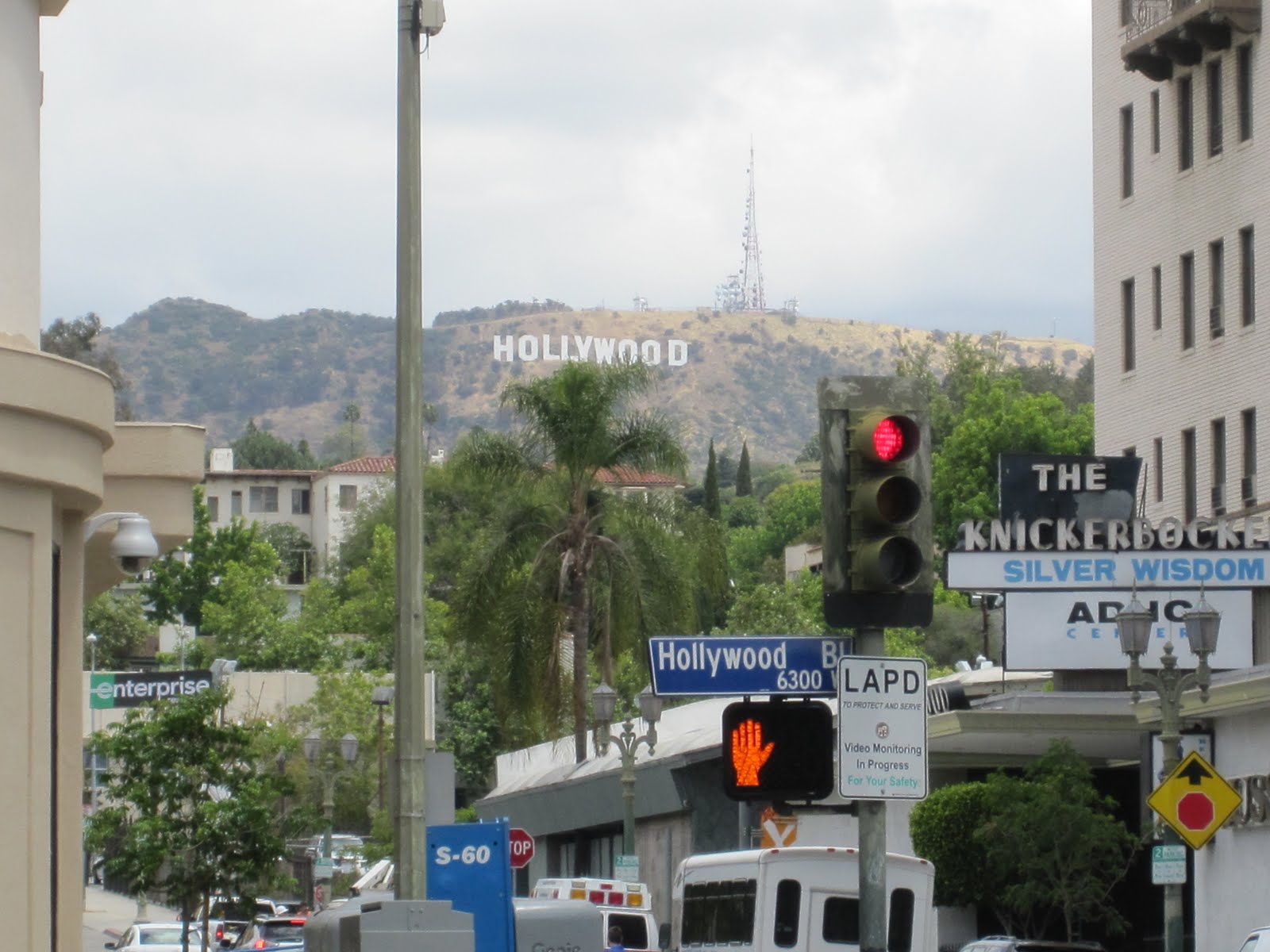
Anyway, bright and early Monday, at a little before noon, I locked my car in front of the Museum of Death on Hollywood Boulevard just west of Gower, where the two-hour free parking spaces end. I ambled west, past empty store fronts, dirty lingerie shops, and souvenir t-shirt stores, nearing the heart of the tourist district. Excited Germans paused on street corners to take one another's pictures with the HOLLYWOOD sign in the background. Around them ambled the human marginalia of this particular page of life--raggedy bag women, over-made-up costumed wackos, old gone wrinkled cowboys come to spend their golden years in whiskey and handouts. I looked for some sign of the OBSOG, maybe his pull-behind two-wheeled grocery cart packed with black plastic bags packed in turn with who knows what (standard issue for self-respecting street people), or his sign warning of the impending end of days. Eventually I decided to start inquiring about him among the people who looked as if they spent all day there, nearly every day.
The first person I asked was a huckster of indeterminate nationality, but probably from one of the southern Slavic countries or maybe Armenia. He said he knew who I was talking about, and that he usually hung out farther west, near Hollywood and Highland. Up at that intersection the second person I approached was a young good-looking Middle Eastern guy of about 30 who was selling tours of the homes of the stars. I asked him if he had seen "the End of the World guy," with the beard and the shopping cart. He knew the OBSOG by my description right away, but said he said he hadn't seen him for a week or so. "What's wrong?" he asked. I said that nothing was wrong, just that I wondered where he was today.
"Don't worry," he reassured me in his thick Arabic accent. "Nobody can say when is end of the world. Jesus no say. Mohammad no say. Ibrahim no say. Only God says. Have a good time, relax." I said I really wasn't worried about that, but merely wished to speak to the guy. I explained that he had predicted that the end of the world would happen yesterday. I could tell that although the Arab had rather enjoyed this momentary diversion, I was beginning to waste his time. And he was wasting mine.
Other reactions from the Hollywood tour and map-of-the-stars salesmen were predictably similar. There was, I sensed, a loose solidarity among the everyday folk of the boulevard. One young man asked me, laughing, if I was looking for him to get my life savings back. My first thought was to answer, "Do I look like a complete idiot?" Then it hit me. Of course I look like a complete idiot, to him and all the regulars. I look just like the rest of the goofy tourists from middle America and Europe who traipse up and down the street, gawking, taking snapshots, posing in front of the Chinese Theater with people dressed as Spiderman or Elvis or Shrek or Darth Vader. Why else would I even be here? On Hollywood Boulevard you're either selling or buying. And if by chance you should be wandering aimlessly, the Church of Scientology lies patiently in wait, a wolf among lambs.
Meanwhile, even absent the OBSOG, there was no shortage of religious types afoot. Near the Chinese Theater I passed a pair of amateur musicians playing softly while handing out tiny tracts identifying themselves as a German outfit predicting the end of the world in December 2012--12/12ers, I guess you could call them. Then, to my surprise, I came to a pair of young Mennonites, also handing out pamphlets, offering merely garden-variety Christian salvation, minus the imminent cataclysm. I stopped to talk to a young man of this persuasion, who informed me that a large group of them had traveled to Los Angeles to save souls, and were staying in a hotel. I said I didn't realize the Mennonites were evangelists, and he told me that at least his group was. The guys were mostly clean shaven and conservatively dressed, and the women wore full-length print dresses from which sensible gym shoes protruded, and little white lace bonnets on the backs of their heads. As in west Texas, I was struck by how homely they were--the girls especially. Inbreeding, I suspect. At one corner an a capella choir of about twenty of them earnestly sang hymns--regular church hymns I recognized from my own childhood. The voices, at least, were pretty. I paused and leaned against a palm tree and absorbed the sweetness of the sound, traveling back half a century in my mind.
When I got to Orange Street I asked another local, who told me that he knew of the OBSOG, but that I had ventured a bit beyond his territory, which he said was strictly between Vine and Highland, on the south side of Hollywood Boulevard. That had indeed been where I'd seen him on Oscar night. I began walking west again, carefully scrutinizing all the people with those shopping carts and huge plastic bags, ranging through the trash cans, looking for redeemable empties rather than redeemable souls. In a little courtyard set back from the sidewalk in front of some sort of cheesy museum I asked a homeless Japanese man if he'd seen my bearded End of the World guy. He was more precise than the others. "Not today," he said, his bloodshot eyes scanning me warily. "But last week." Why did I want to know? the eyes said silently. This man's information I instinctively took to be a bit more reliable than that of the tour people, because this guy probably knew where the OBSOG spent his nights, back on the side streets behind dumpsters. But I didn't want to invade anyone's home, only to see him here on the street, in his element. I did venture down El Centro to an alleyway, where the empty bottle and can people looked at me furtively, just as the residents of a suburban cul-de-sac might eye a scruffy stranger to their domain.
I didn't find the OBSOG this time, but I haven't given up hope. No doubt he's busy recalculating, not to mention revising his manifesto to accommodate the obvious fact that it's earlier than he thought it was. These things happen. Calculations, unlike the mighty adversaries in the battle of Armageddon, are only human.
Monday, May 30, 2011
Weather Report

Southern California
Wednesday, June 1, 2011
There's another deadline for the end of the world coming up this Sunday, June 5, according to my guy on Hollywood Boulevard. The Armageddon came the day before yesterday, May 30. After that, he says, you'll be hoping for the end of the world, what with the flooding, earthquakes, tornadoes, and all the other plagues that'll be descending on us for the six days to follow. Funny thing, though, the big news here is the sameness of the weather. Sunny, highs in the mid 70s to low 80s. The calm before the storm? Maybe the bad stuff isn't going to happen until the last second.
Which reminds me. All of us are aware of the latter-day phenomenon of weather hysteria, in which even the tiniest hint of impending inclemency causes the local weather folks to interrupt our regularly scheduled programming with dire warnings or at least to put a little box in the lower corner of the screen with the word "warning" or "watch" on it, diverting our attention from the picture. Some blame this on the advent of the Weather Channel, but I think it was part of a nationwide coup by weather people, always in the past relegated to third-place behind the news and sports people, to wrest time and attention from them by making the weather the news as often as possible. Another theory I heard for the increase in weather presence on TV is the advent of more sophisticated satellite weather tracking equipment. I do not believe this for two reasons. First, modern weather tracking equipment is no better able to predict the weather more than a day or so in advance than whatever old shit we had before. Now, as then, the best way to find out what the weather will be tomorrow is to call someone who lives a couple of states west of you. Second, the weather hysteria that grips the nation's local stations is most of the time not about actual storms, but about the possibility of storms. Rumors of storms.
You might be asking, why is he off on this tangent? Well, here in southern California they've taken weather hysteria to new and (perhaps appropriately) more dramatic levels. Here virtually any possibility of rain, even a gentle rain that droppeth like the quality of mercy, is deemed to be an impending storm. The other day it was raining outside, just like it does half the time throughout the nation. No high winds, no hail, no frogs, no blood. Just plain old rain, and not much of it, at that. The 11:00 a.m. newscast led with the story. They had a roving reporter stationed in a suburban town, interviewing people about the rain, for Christ's sake.
"Hi, I'm Rachel Hairspray, reporting from downtown Monrovia, where I'm talking to people about the rain. Sir, how is the rain affecting your day so far?"
"Well, I was, like, going to take a bike ride, you know? But dude, now I guess I'll have to do it some other day."
"Well, there you have it. This is Rachel Hairspray reporting from Monrovia, where the rain is turning out to be having a pretty big impact on lots of folks. Oh, and they say it might be raining this afternoon for your commute home, so be careful and expect some slow going. Back to you, Nancy."
Had you seen that telecast you would know that I wasn't exaggerating a bit. And telling people in the greater Los Angeles area to expect slow going during their afternoon commute is a little like telling an Eskimo to expect snow. And I would be remiss if I didn't mention that by the middle of the afternoon it had stopped raining.
Shifting gears again, Armageddon is an interesting phenomenon, subject to quite a bit of variation, depending on one's interpretation of the scriptures. For most it is the battle between Christ and Satan, following which Satan will be put in his place for a thousand years. For others it is whether their particular religion will be persecuted, or will triumph. It's a mishmash, at best. For many Armageddon is just shorthand for the day when the shit hits the fan, or at least begins to fly in the general direction of the fan. My guy in Hollywood's slim period of six days is a drastically truncated version of things, and suggests that he's of an independent turn of mind, although I suspect he might have broken away from the Jehovah's Witnesses at some point. This is just speculation, partially based on the text of his rambling handwritten manifesto, running to about thirty pages, in which he makes his predictions, all the while pointing out that the Antichrist is chiefly represented here in the U.S. by his minions in the Republican Party. My kind of guy.
Assuming his predictions don't come to pass in any readily discernible way (I wonder if it could all come to pass and be missed by practically everybody, like the posting of the order to destroy the earth to make way for a galactic highway in that Douglas Adams book?), I plan to go to Hollywood next Monday and try to find the Only Begotten Son of God, and seek out an explanation. Who knows, he might have one.
Sunday, May 22, 2011
After The Raptor

Monrovia, California
Wednesday, May 25, 2011
If you're reading this, chances are good that, like me, you weren't taken up into heaven in the Rapture on May 21, 2011, unless heaven is far different from what I conceive it to be, which is very possible. Nor were you swallowed into the bowels of the earth in the gigantic earthquake that rent asunder the crust of the planet.
I am happy to know that you're still here, because even if there are trials to come, say for the next five months--plagues, famine, pestilence--it'll be good to be in the company of friends while we rue the day our mothers brought us forth into this bitter vale of tears. Ruing always goes down better in company, although it can lead to some real mischief, too, as in the period of mass ruing that led to the rise of National Socialism in Germany. But hey, we've only got five months, so how bad can it get? Well, in the words of Clemenza in The Godfather, "Pretty goddamn bad. Probably all the other families will line up against us...." But I digress.
This guy Harold Camping, who had some people in a tizzy, now says the real end of the world won't come for five months, on October 21, 2011. Well, duh. Even amateur eschatologists know that the Rapture, when the dead in Christ rise and then the living who are saved go up into the clouds to join them, has to be followed by some sort of Tribulation, i.e., bad shit for all who remain. After that things get muddy, and time lines and predictions of specific results often vary widely and wildly, depending on whether you're a Dispensationalist Premillennialist, an Amillennialist, a Two-seed-in-the spirit Predestinarian, or whatever. My question to Camping is this: how do you know the Rapture didn't take place last Saturday, May 21, 2011, and the dead in Christ weren't taken up along with all the living who were worthy of going straight to heaven? Just because you didn't go? That's rather presumptuous. Have you checked inside any graves lately? Maybe the number of souls, living and dead, who get to go straight to heaven in the Rapture is so tiny in relation to the world's total historical population (say 144,000) that you didn't notice. One thing we do know, at least, Harold Camping, is that your sorry ass is still here, along with ours.
By the way, the word "rapture" comes from the same Latin root as the word "raptor." It has to do with being "taken up," the same way a giant predatory bird, or perhaps a dinosaur, takes up its prey in its talons. And metaphorically speaking, I suppose getting taken in by someone or some idea is quite a similar concept. We give our "rapt" attention when we are absolutely taken by what is being said or who is saying it. Same root word.
When one of my daughters was a little girl she went to Sunday school with a girlfriend of hers and saw a picture of an angel, wings spread, which had a profound effect on her. The impression she got was that if you went to that church, a giant bird would come and grab you and take you away. How far off was she, I wonder? Taken up, taken for a ride, taken in.
By which I don't mean to ignore my man on the streets of Hollywood, the Only Begotten Son of God, whose predictions haven't had a chance to play out yet. And let's face it, Hollywood usually does have the last word in these matters.
Subscribe to:
Posts (Atom)